
Hello,
Today I’d like to talk about one observation I’ve made while talking to my client (not giving any names here, as usual, but we’re talking mostly about B2B services with certain regulatory requirements).
Just a sidenote: the observation was not so clear to a group of very intelligent an certainly highly skilled people, so it is all but « self evident ».
Let’s say we have a business process based mainly on two major systems (with a number of satellite systems which are of no interest here):
- System A manages all information about the details of the services the company provides;
- System B manages most of FI stuff.
Major business problems here (I’ve nearly written « opportunities »):
- The system A is way too open for modifications, so third party data is somewhat messy (thus we have quite a lot of problems with invoices, with regulation and so on), we need « some governance » to build;
- The whole workflow is way too distributed geographically and there is a real need to introduce a centralized CRM and to manage the sales in a more optimal way.
I’ll skip 3 months of work and discussions, here you go with the ideas:
- Set up an MDM process with BPM-like workflows and a proactive Data Quality
- Why: the system A cannot be changed the way we want, the process we want is already documented quite well, we can expand the success to the supplier management later;
- Why not: the whole thing is being seen as overly complicated (« we all know that MDM is not going to happen tomorrow »)
- Set up a CRM, which will be tuned to cope with all our DQ needs and governance processes
- Why: anyway, we need a CRM, so adding a few features to an existing solution should not be a problem.
That’s where I felt I’ve been beaten in my own game… it looks like a very logical approach. All my and-what-abouts have been met with « we’ll add this too, thank you for your analysis ».
Here you go with a mind model, which somehow changed the discussion.
If we talk about the whole process, we can oversimplify it to see a number of steps from Lead Generation to Billing (and Cash Collection). The leftmost part does not need the same level of details about our future clients as does the right one, so at some point we need someone to care about all this information (« bridge »).
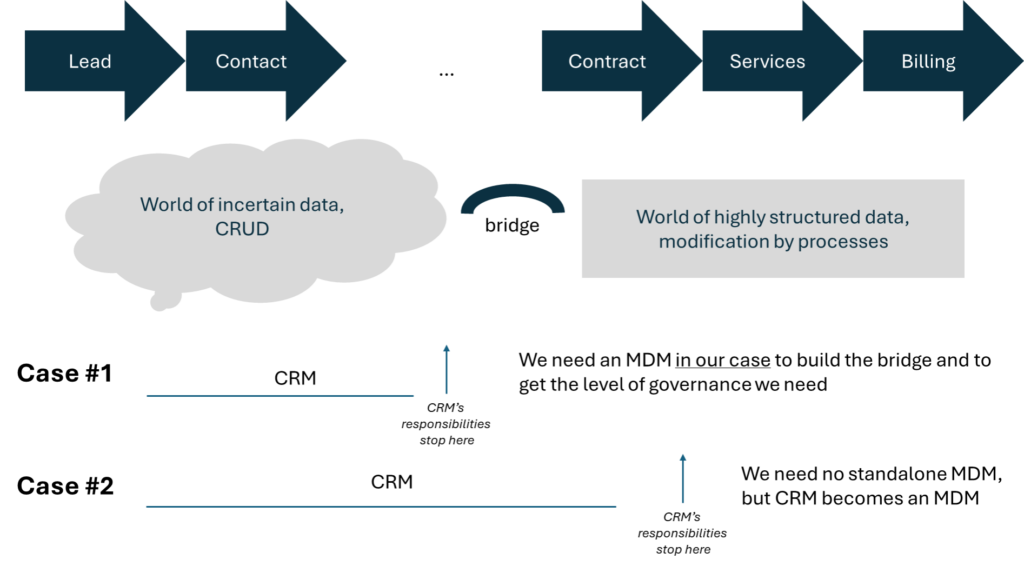
Hopefully the schema is clear: it all depends on the responsibilities of our « CRM » – if it stops before the moment when we need (in our case) a very stuctured approach to the data manipulation, we need something to make the bridge to this stuctured vision, but if not – whatever you call it, it is more than a CRM – it becomes an MDM with all its complexity.
Conclusion: there is no free lunch if we want to address the whole list of problems I’ve found.
Your experience may be different, let me know in the comments.
Good health to you and to your Data Owners.
P.S. Personal opinion not applicable for this client: purrfect solution is when everything is in one place, i.e. there is no separate CRM, MDM, ERP… difficult, but feasible and only if you start from scratch.